Q&A with Roamin' Rich about the newly renovated Shamrock Court Motel— Sullivan, MO. on historic Route 66:
Meet Rich and Christina Dinkela, the owners of the legendary Shamrock Court Motel on Route 66! The heartbeat of Route 66 keeps going because of passionate people like Rich and Christina, who are willing to invest their time, energy, and resources into preserving its history. This Q&A series takes you behind the scenes at the historic motor court that sat abandoned for years before being thoughtfully and painstakingly brought back to life.
The Dinkelas also recently acquired the iconic Wagon Wheel Motel in Cuba, Missouri, shortly before the passing of its longtime proprietor, Connie Echols. We’ll revisit the Wagon Wheel in a future feature, as both of these remarkable properties deserve their own moment in the spotlight.
Stay tuned—you won’t want to miss the stories behind these Route 66 treasures.
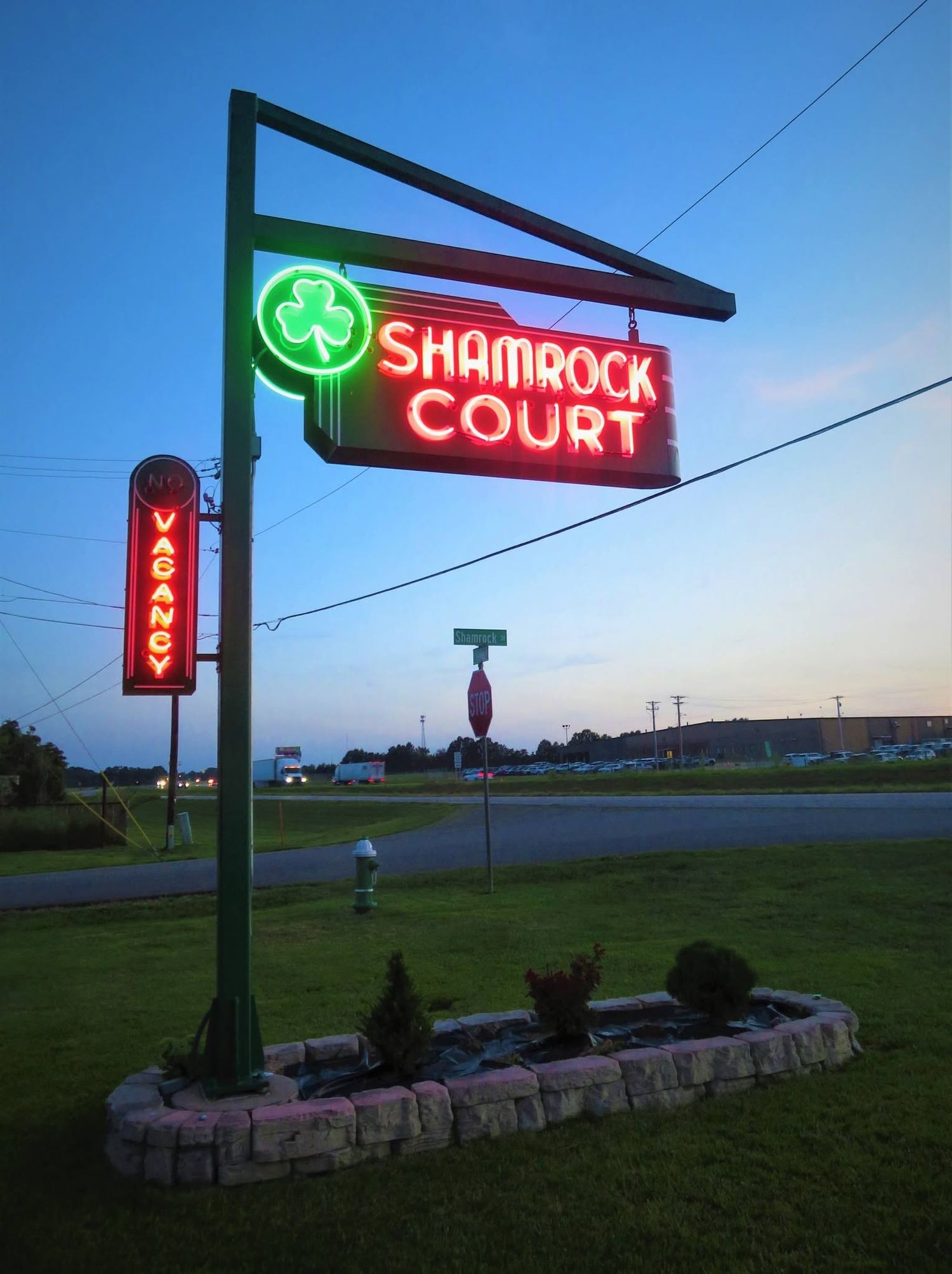
You’ve done an incredible job restoring Shamrock Court while preserving its historic character. What inspired your approach to the renovation and design? Now that the major work is behind you, has it been rewarding to focus more on maintaining the property than constantly repairing it?
The original inspiration was pretty simple: we did not want to see the Shamrock Court demolished. We knew that if somebody did not step in, it would probably suffer a slow and painful death. The motel had deteriorated for decades, but it never lost its ability to captivate people. It is such a whimsical building. Even before we purchased it, I participated in cleanup efforts there with the Route 66 Association of Missouri. At every stage—from those early cleanups, through the restoration, and eventually the reopening—people would stop, look around and develop these enormous grins. The place seems to put people under a little spell.
Our approach was never to manufacture a fake version of 1948. We wanted to preserve the historic character and unmistakable architecture of the property, but we also had to decide what kind of experience we wanted to provide inside the rooms. When the Shamrock originally operated, the rooms were relatively simple: a bed, a heater, some lights, a bathroom, a shower and hot water. That was essentially it. We considered recreating that kind of low-frills experience, but then we went back and studied how the motel was advertised. One word appeared repeatedly: modern.
The Shamrock even had a large neon sign advertising it as a “Heated Motel,” with the word “MODERN” displayed prominently. Modernity was part of its identity from the beginning. That led us to ask a different question: If we could travel back to 1948, pick up the people who designed and constructed the Shamrock, and bring them forward to see the world of today, what would they want this motel to become?
I believe they would be astonished by the technology available to us, but I also believe they would still want the Shamrock to be modern. If we showed them a flat-screen television, they would probably say, “We have to put those in the rooms.” If we showed them refrigerated air and a compact modern heating and air-conditioning system, I think they would want that too.
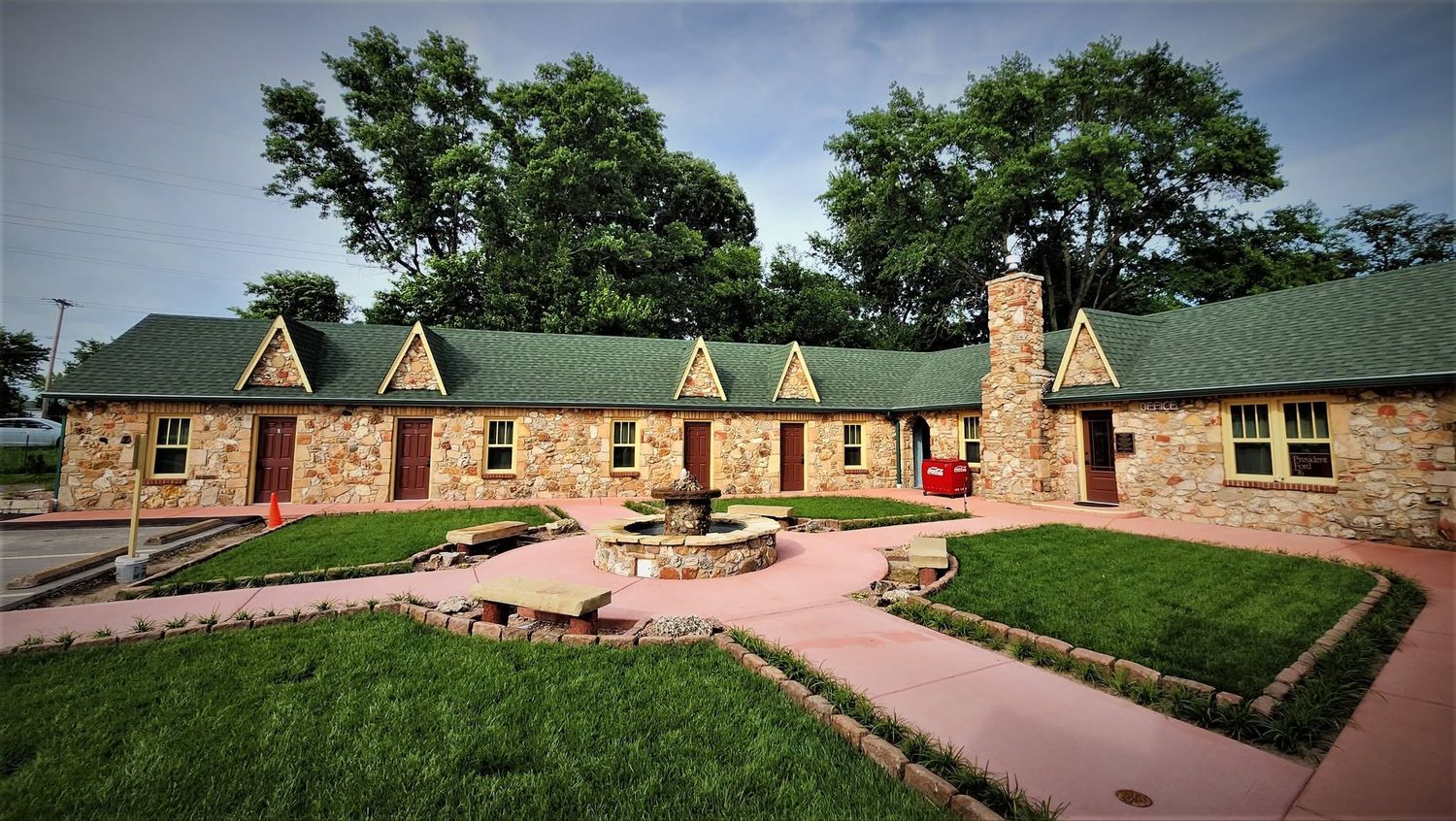
Some people might call those luxuries a departure from the original interior experience. I see them as a continuation of the same ambition the builders had 75 years ago. They wanted their motel to be modern in 1948; we want it to remain modern today. The exterior is still unmistakably 1948. We preserved the architecture, the stonework and the historic roadside character. At the same time, we changed the parking arrangement and created the courtyard, fountain and green space. None of that existed in precisely this form in 1948, but it complements the building and gives people a better way to experience it.
I believe that if the original builders could stand in the courtyard today, they might go back to 1948 and say, “We need to build one of those.”
As for the major work being behind us, I am not quite brave enough to declare victory. We still have rooms and projects ahead of us, and historic buildings have a remarkable ability to develop new opinions about how you should spend your time and money.
Nevertheless, it is deeply rewarding to spend more time maintaining and improving the property instead of constantly fighting to keep it from collapsing. For years, nearly every visit uncovered another disaster. Now we can look across the courtyard and see lights glowing, cars parked outside, children playing and guests enjoying the motel. That is a completely different feeling.
With the Route 66 Centennial, how do you think it will shape travel on the Mother Road going forward? Do you see it creating lasting support for independently owned businesses like Shamrock Court, which have always been the heart and soul of Route 66?
This is a difficult question for me because I want to be optimistic, but my honest answer is: probably not—at least not automatically, and not based on much of what I have seen in Missouri or at the federal level. Some states, particularly Oklahoma and perhaps Illinois, have made more meaningful efforts. Here in Missouri, however, the Centennial has placed very little serious focus on the independently owned businesses that actually keep Route 66 alive. Too much of it has felt like a grand virtue-signaling exercise for politicians, bureaucrats and Johnny-come-latelies who want to stand in the spotlight now that the Centennial has made Route 66 fashionable.
Some of the projects will have a positive economic impact. Missouri and Illinois have installed large interactive Route 66 sculptures designed to make travelers stop, get out of their cars and take photographs. I support that. Anytime you can get someone out of a car, you increase the likelihood that they will explore the community and spend money at a nearby mom-and-pop establishment. If they never stop, that opportunity may simply disappear farther down the road.
But by and large, I think much of the Centennial’s focus has been misguided. Instead of devoting nearly all our energy to celebrating the last 100 years, we should be asking what Route 66 will look like 10, 15 or 25 years from now. How are we going to preserve the buildings? How are we going to help independently owned businesses survive? How are we going to make it possible for another generation to take responsibility for these places?
We have lost numerous Route 66 businesses and historic places in just the last several years—and even within the last 12 months. That is disheartening, but it is also sobering. It demonstrates the difference between celebrating Route 66 and saving it.
We can have parades, balloons, fireworks, commemorative signs and speeches. Those things may make everyone feel good for a moment, but they do not necessarily save a motel, restaurant, gas station or roadside attraction. When the celebration ends and the cameras leave, the owner still has utility bills, payroll, insurance, repairs and another slow Tuesday night ahead.
If we spend all our time congratulating ourselves because Route 66 reached 100 years, we risk mistaking survival for preservation. People may decide the mission has been accomplished when the real work has barely begun. I want to maintain positive energy, but I have difficulty doing that when virtue signalers and Johnny-come-latelies cast a shadow over the business owners, historic figures, buildings and longtime preservationists who actually matter.
I am willing to say that publicly because very few other people seem willing to say it—and because it needs to be said.
The Centennial will generate attention. What I question is whether that attention will produce anything lasting. The success of the Centennial should not be judged by the size of the celebration in 2026. It should be judged by how much of Route 66 is still standing, operating and economically viable in 2036.
Restoring Shamrock Court has been an extensive, time-consuming labor of love. Since reopening, what guest feedback has inspired, or perhaps surprised you the most?
“Labor of love” sounds very romantic once the worst of the labor is behind you. While you are living through it, it is exhausting, frustrating and sometimes financially terrifying. We were in close contact with our followers throughout the restoration, particularly through the “Saving the Shamrock Court” Facebook group. Because of that, we developed a pretty good finger on the pulse of what people thought about the property. We already knew that adults were fascinated by the building. We had watched it happen for years.
What has surprised and affected me most is the reaction from children. Kids arrive and immediately begin exploring. They run along the sidewalks, ride their scooters through the courtyard and inspect the rocks, phone booths, wishing well, fountain and neon. There is something about the scale and whimsical nature of the Shamrock that seems to connect with them. That means a great deal to me because I remember having similar experiences as a child. My family visited the Ozarks, and I remember staying in little rock cottages. I may have been only three years old, but those places made an impression on me. Perhaps that impression was sitting quietly in the back of my mind for the next 30 or 40 years without me fully recognizing it.
Now I watch children experiencing the Shamrock and wonder whether we are planting a similar memory.
Maybe someday they will say, “When I was a kid, we stayed at this unusual old motel with rock cottages, a fountain and neon signs.” Maybe that experience will influence how they view historic buildings or family travel later in life. When you get a strong reaction from a child, you know it is genuine. Children are not complimenting your preservation philosophy to be polite. If they are fascinated, they show it. If they are bored, they show that too. Seeing those kids connect with the Shamrock is one of the things that inspires me to continue. It tells me that we are not merely preserving someone else’s memories. We are creating new ones.
Meeting travelers is such a big part of owning a historic Route 66 motel. What has been the most rewarding aspect of connecting with guests from around the world?
The most rewarding part is watching people form relationships—not only with us or with the motel, but also with one another.
The courtyard was purpose-built to encourage those encounters. I created corridors and pathways that are not uncomfortably narrow, but are intimate enough that people naturally cross paths. Guests come out of their rooms, see someone else sitting nearby and begin talking.
They compare the uniqueness of their rooms. They discuss where they are from, what they have already seen on Route 66 and where they are going next. People who were complete strangers 15 minutes earlier may spend the rest of the evening exchanging stories.
That is important to me because the Shamrock has become more than a collection of rooms. It is a meeting place where people can establish new friendships and create memories they may talk about for the rest of their lives. We never know what kind of profound impact one of those encounters might have or what positive role it could play in the future.
It is still surreal for me to look at the Shamrock Court—and now the Wagon Wheel Motel—and realize that I own these pieces of Route 66.
I never dreamed of owning Route 66 in this manner. In fact, I fought against it. I resisted it. I repelled it. I was Roamin’ Rich, not Brick-and-Mortar Rich. I wanted the freedom to travel, explore and remain relatively uncommitted to one particular piece of the road. But Route 66 kept chasing me down. It kept hounding me until eventually I could no longer deny whatever force of energy was pushing me in this direction. So I acknowledged it and took it on.
Some days are tougher than others, and some are more rewarding than others. But I believe—for reasons I cannot completely explain yet—that these properties and the human connections taking place within them will eventually have a much larger impact than I can presently conceive. For now, I am simply happy to be here in this moment, watching the Shamrock live again and seeing people from around the world become part of its continuing story.
Inspired by Rich and Christina’s journey?
Visit Shamrock66.com to book your stay.
Join the Saving the Shamrock Court Facebook group to follow the ongoing restoration and become part of the story. The Mother Road survives because people like you choose to experience—and support—places like the Shamrock Court.
My name is Jay Farrell, a Nashville, Tennessee-based fine art photographer and author of Route 66 Roadscapes coffee table book. If you'd also like to support my work, I'd be honored.